2026
This is not an edge case. It's the math for a mid-sized operator who built their income model the same way almost everyone in the industry did over the last decade: layering ancillary fees on top of base rent to drive NOI without touching the advertised price.
The FTC is now coming for that model. And the damage won't happen once, it'll happen twice. Two separate waves that hit different operators in different ways at different times. Understanding both waves is the difference between getting ahead of this and getting caught flat-footed.
What the FTC Is Actually Doing Right Now
This isn't a rumor or a distant regulatory threat. The timeline is already in motion.
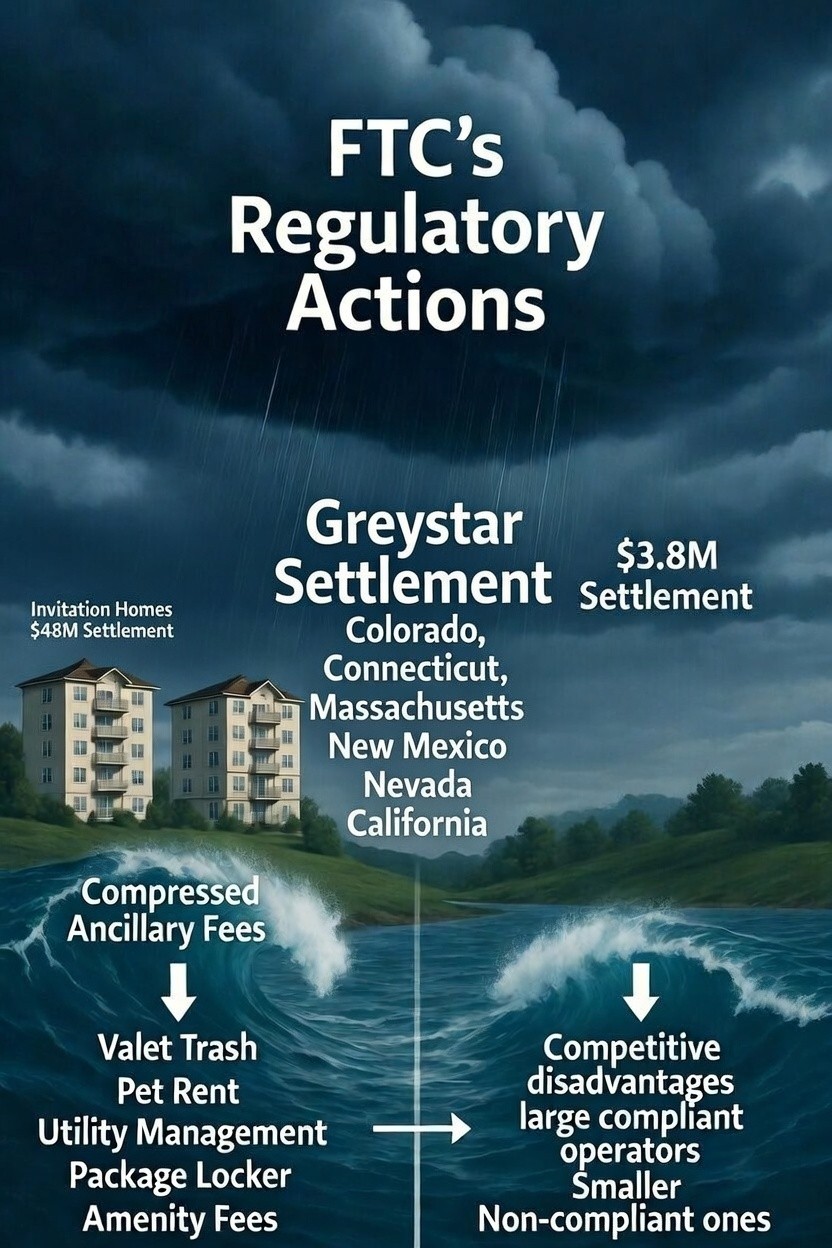
The FTC has already taken two landmark enforcement actions against major multifamily operators. In 2024, Invitation Homes, the nation's largest single-family rental operator, settled FTC allegations about concealed mandatory fees for $48 million. In December 2025, Greystar, the largest residential property manager in the country, settled a joint FTC and Colorado action for $23 million and was required to reform all fee disclosure practices.
The FTC's message after the Greystar settlement was explicit: the agency is now examining whether case-by-case enforcement is sufficient, or whether a sector-wide rule covering the entire rental housing market is needed.
On January 30, 2026, the FTC submitted an Advance Notice of Proposed Rulemaking (ANPRM) targeting fee practices in rental housing to the Office of Management and Budget for review. On March 12, 2026, the FTC formally opened a 30-day public comment window on the proposed rule making.
Although an ANPRM is an early step in the formal rule making process, it's a serious one. It creates the official regulatory record that shapes the final rule. The industry has a narrow window to engage. After that, the rule gets written without you.
Meanwhile, states aren't waiting for federal action. Colorado's junk fees law took effect January 1, 2026, requiring all advertised prices to include mandatory fees as a single total number. Connecticut follows July 1, 2026. Massachusetts, New Mexico, Nevada, and California are all in various stages of similar legislation. The patchwork is already here.
Wave One: The Direct NOI Hit
The first wave is straightforward. If the FTC mandates full upfront disclosure of all mandatory fees (or bans certain fees altogether) ancillary income compresses immediately across every portfolio in the country.
The fees at risk are the ones that have driven the most margin expansion over the last decade with the least associated cost:
Valet trash: $25–35/month per unit
Pet rent: $25–75/month per pet
Utility management/RUBS fees: $15–30/month per unit
Package locker and technology fees: $10–25/month per unit
Amenity and common area access fees: $20–50/month per unit
For a 500-unit portfolio averaging $150/month in combined ancillary fees, that's $75,000 in monthly revenue, $900,000 annually. That has historically been booked as near-pure margin because the costs of delivering these services are minimal compared to what residents pay.
If mandatory fee disclosure forces those fees to be baked into advertised rent, or if certain fees are banned outright, that margin doesn't just compress. It disappears. And unlike cutting operating expenses, there's no operational lever to pull to replace it.
For operators on floating-rate debt or approaching a refinance, losing 3–4% of NOI from fee compression isn't an inconvenience. It's potentially a covenant violation or a valuation reset that turns a viable deal into a distressed asset.
Wave Two: The Competitive Disadvantage That Hurts Honest Operators More
The second wave is more insidious, and this is the one most operators aren't modeling.
Federal rule making doesn't enforce uniformly. Large institutional operators with recognizable brand names and legal departments are the ones the FTC is watching. They're the ones who will comply first, fully, and visibly, because the reputational and legal cost of non-compliance is existential for them.
Smaller operators, regional portfolios, and private landlords who don't have a Greystar-sized legal team or a publicly visible brand have far less enforcement risk. Some will continue advertising base rents below the true all-in cost. They can misclassify fees as optional, delay disclosure until after application, or simply operate below the FTC's enforcement radar.
Here's how this plays out in a real leasing market:
An institutional operator complying with full disclosure advertises a true all-in cost of $1,800/month. A smaller competitor advertising $1,600/month with $200 in mandatory fees disclosed only after application gets the call, gets the tour, and closes the lease. The honest operator loses the lead.
This isn't speculation. It's what happened in the hotel industry when mandatory resort fee disclosure rules went into effect at the state level before federal standards caught up. Properties that complied early showed higher nightly rates in search results and lost bookings to non-compliant competitors, even when the total cost was identical.
The damage in multifamily is compounded by lease-up timelines. A lease-up disadvantage of even 30–60 days per vacancy, sustained over 12–18 months of a compliance transition period, translates into real occupancy loss that doesn't come back. The operators who captured occupancy during the run-up to full enforcement will have locked in residents under favorable terms. The compliant operators will be starting from a worse position when the playing field finally levels.
Why Ancillary Income Was Always More Fragile Than It Looked
The honest version of this conversation is that a significant portion of ancillary fee income was never a stable, defensible revenue stream. It was a structural arbitrage enabled by information asymmetry: residents paying for fees they didn't fully understand, with no easy way to compare total costs across competing properties.
Regulators closing that information gap isn't surprising. What's surprising to me is that it took this long…
The operators who built NOI models heavily dependent on ancillary fees made a bet that the regulatory environment would stay static. That bet is being called. The ones who will fare best are the ones who identified alternative, defensible NOI sources BEFORE the disclosure rules take effect, not after.
What Operators Should Do Before the Rule Takes Effect
1. Model your NOI without ancillary fees now
Don't wait for a final rule to understand your exposure. Pull your trailing 12 months of ancillary fee income by fee type, stress test your NOI at 25%, 50%, and 100% compression, and understand exactly where you sit on debt covenants and refinance metrics if those fees disappear.
2. Engage in the public comment process
The FTC's 30-day public comment window is open now. Industry comments on proposed rule making directly shape the final rule. If mandatory fee disclosure is coming regardless, the specific implementation details (what counts as mandatory, how disclosure timing works, what exemptions exist) are still being written. Operators who submit substantive comments have a voice in that process. Those who don't are accepting whatever the rule says.
3. Build NOI sources that don't depend on fee opacity
The most durable response to ancillary fee risk is building income streams that deliver real value to residents and operators simultaneously. Where the revenue is defensible regardless of how disclosure rules evolve.
Resident insurance programs are the clearest example. A properly structured profit-sharing insurance program generates $200–300 per door annually in net profit to the ownership group. Not from mandatory fees charged to residents, but from the underwriting profit on optional insurance products residents are already paying. The resident pays market rate for coverage they actually need. The operator captures the profit margin that would otherwise go to a carrier.
That revenue doesn't appear as an ancillary fee. It doesn't show up in an advertised rent calculation. It doesn't get caught in a mandatory disclosure rule. It's underwriting profit flowing back to ownership, a fundamentally different economic structure than a valet trash fee.
The operators who will be best positioned when ancillary fee compression hits are the ones who replace fee-dependent NOI with ownership-aligned income structures before the rule takes effect. That window is narrowing.
The Bottom Line
The FTC's rental housing fee rule making is moving forward. The enforcement pattern (Invitation Homes, then Greystar, now a sector-wide rule) makes the direction clear. Operators who treat this as a distant regulatory concern are underestimating both the timeline and the cascading competitive dynamics that come with uneven enforcement during the transition period.
The $240,000 NOI figure I opened with isn't a worst-case scenario. For many mid-sized operators, it's the base case. The question isn't whether ancillary fee income is at risk. It is. The question is what you're building to replace it.
If you want to see what your portfolio's NOI looks like with ancillary fee compression modeled in, and what alternative income structures could offset it: I offer free 20-minute portfolio audits. We run the numbers on your specific situation and show you exactly where the exposure is and what the options are.
Book directly on our booking page at www.insur3tech.com.