2026
What Is a Risk Retention Group (RRG) and How Does It Work in Real Estate?
If you have looked into alternative insurance structures for your real estate portfolio and encountered the term Risk Retention Group, you may have found the explanations either too technical to be useful or too vague to act on. This post fixes that.
A Risk Retention Group (commonly abbreviated RRG) is one of the most powerful and underused tools available to real estate operators. Understanding what it is, how it works, and why it exists is the first step to determining whether it belongs in your portfolio strategy.
The origin of Risk Retention Groups
RRGs were created by federal legislation through the Liability Risk Retention Act of 1986. This act specifically gave businesses a way to pool their liability risks and self-insure without being subject to the full regulatory burden of forming a traditional insurance company in every state where they operate.
Before the Act, forming a group self-insurance structure required compliance with insurance regulations in every single state where participants operated. For a real estate operator with properties in five states, that meant five separate regulatory filings, five sets of compliance requirements, and five capital reserves. The friction was prohibitive.
The Liability Risk Retention Act changed that. RRGs are chartered and regulated in one domicile state and can then operate in all 50 states under federal preemption. The regulatory overhead collapses from 50 states to one.
What an RRG actually does
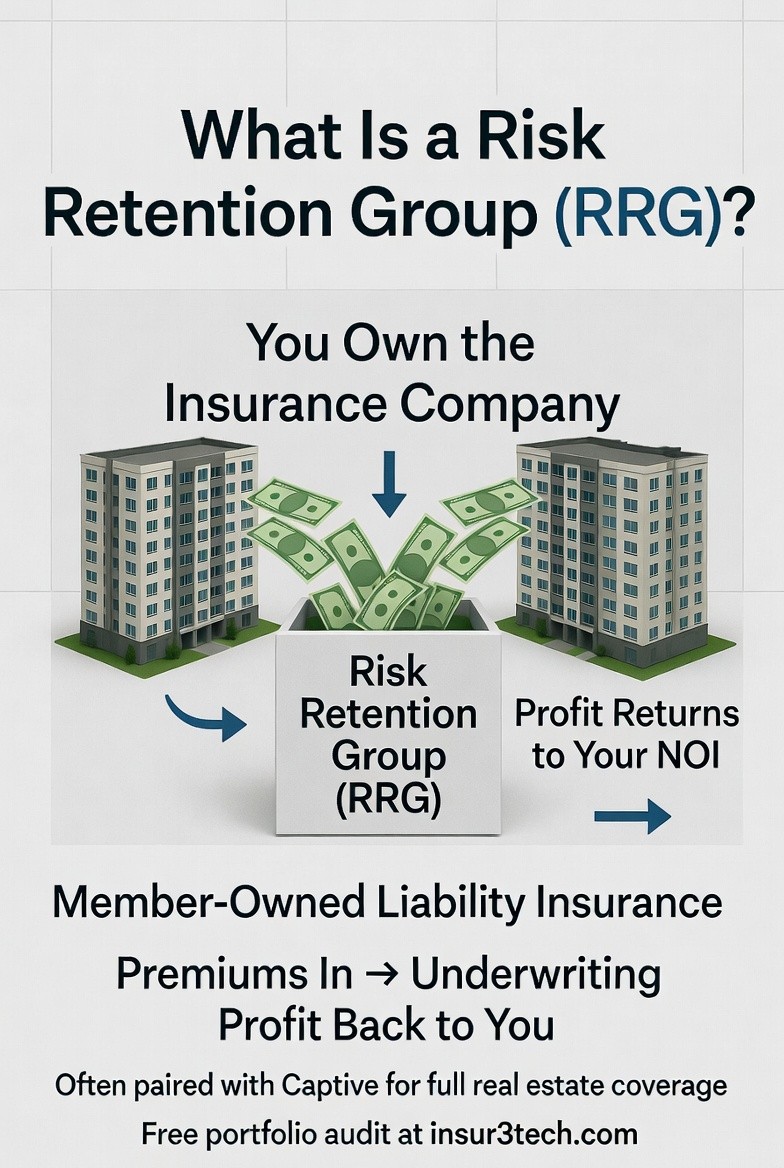
An RRG is a liability insurance company owned by its members or the businesses it insures. Unlike a traditional carrier, an RRG can only write liability coverage (not property coverage, which is why RRGs are often paired with other structures for full-stack real estate insurance programs). Members pay premiums into the RRG, the RRG pays claims, and any underwriting profit at year end is retained within the structure and ultimately returned to the members who own it.
The key distinction: in a traditional insurance arrangement, you are a customer. In an RRG, you are an owner: i.e the premium you pay is also an investment in the entity that collects it.
What RRGs can and cannot cover
What RRGs can cover
General liability
Professional liability (E&O, D&O)
Employment practices liability (EPLI)
Tenant liability / renters liability
Excess liability and umbrella programs
Workers' compensation in certain structures
What RRGs cannot cover (federal limitation)
Property insurance — fire, wind, flood, physical damage to buildings
Auto insurance
Health insurance as a standalone product
This is why sophisticated real estate insurance programs like Insur3Tech will typically combine an RRG for liability lines with a captive cell structure for property coverage. The combination gives operators the captive economics of liability (where loss ratios tend to be most favorable) while maintaining appropriate property coverage through complementary structures.
How an RRG differs from a traditional captive
The terms RRG and captive are often used interchangeably, which creates confusion. To learn more about captives, you can read about it in our previous blog post. They are related but distinct:
Scope: A captive is a broad term for any insurance company owned by the businesses it insures. An RRG is a specific type of captive created under federal law.
Coverage: Both can cover liability lines. Captives can also cover property; RRGs generally cannot.
Regulation: RRGs operate under federal preemption and are regulated in one state. Traditional captives are regulated state by state.
Ownership: RRGs require member ownership, you must be an insured to be an owner. Traditional captives have more flexibility in ownership structure.
In practice, the most efficient real estate insurance programs layer both: an RRG for the liability lines (tenant liability, GL, D&O, EPLI) and a captive cell structure for property and other lines. This is the combination that gives operators full-stack coverage while maximizing the profit-sharing economics across all lines.
The economics of an RRG for real estate
Here is what the math looks like at scale. The U.S. real estate sector pays approximately $6 billion annually in renters and tenant liability insurance premiums. The average loss ratio on tenant liability programs has historically been in the 40–60% range — meaning carriers pay out 40–60 cents of every dollar in claims and keep the rest as profit and expense recovery.
In an RRG structure, that underwriting margin (40–60 cents on the dollar) stays within the member-owned entity rather than flowing to carrier shareholders. At $200 per unit per year in tenant liability premiums across a 500-unit portfolio, that is $100,000 in annual premium. If the loss ratio holds at 50%, the underwriting profit available to ownership is approximately $50,000 annually just on the resident liability line alone.
Add the GL, D&O, EPLI, and workers' comp lines, and the numbers become significantly more material for any organization with meaningful payroll and property operations…
Regulatory and compliance considerations
RRGs are not simple to establish from scratch. Formation requires actuarial analysis, a feasibility study, state regulatory approval in the domicile state, and ongoing compliance reporting. For individual operators, this is typically not a DIY project.
The practical path for most real estate operators is to participate in an existing, pre-established RRG structure designed for the real estate industry: contributing premiums, sharing in the underwriting profit, and benefiting from the legal and compliance infrastructure without bearing the full cost and complexity of formation.
This is analogous to how most real estate investors access institutional capital markets. Not by creating their own bank, but by participating in structures that already exist and are built to serve their needs.
Is an RRG right for your real estate portfolio?
The RRG model works best when three conditions are met: the portfolio generates meaningful liability premium volume, the ownership group wants to participate in the underwriting profit rather than just pay premiums, and the operator is committed to consistent participation over a multi-year period (because underwriting profit compounds as loss history improves within the group).
For most operators managing 100 or more units across liability-exposed lines, the economics justify serious evaluation. For operators above 1,000 units, the RRG participation is almost always accretive to NOI and asset value within the first 12–24 months of enrollment.