2026
What Is Profit-Sharing Insurance for Multifamily Properties?
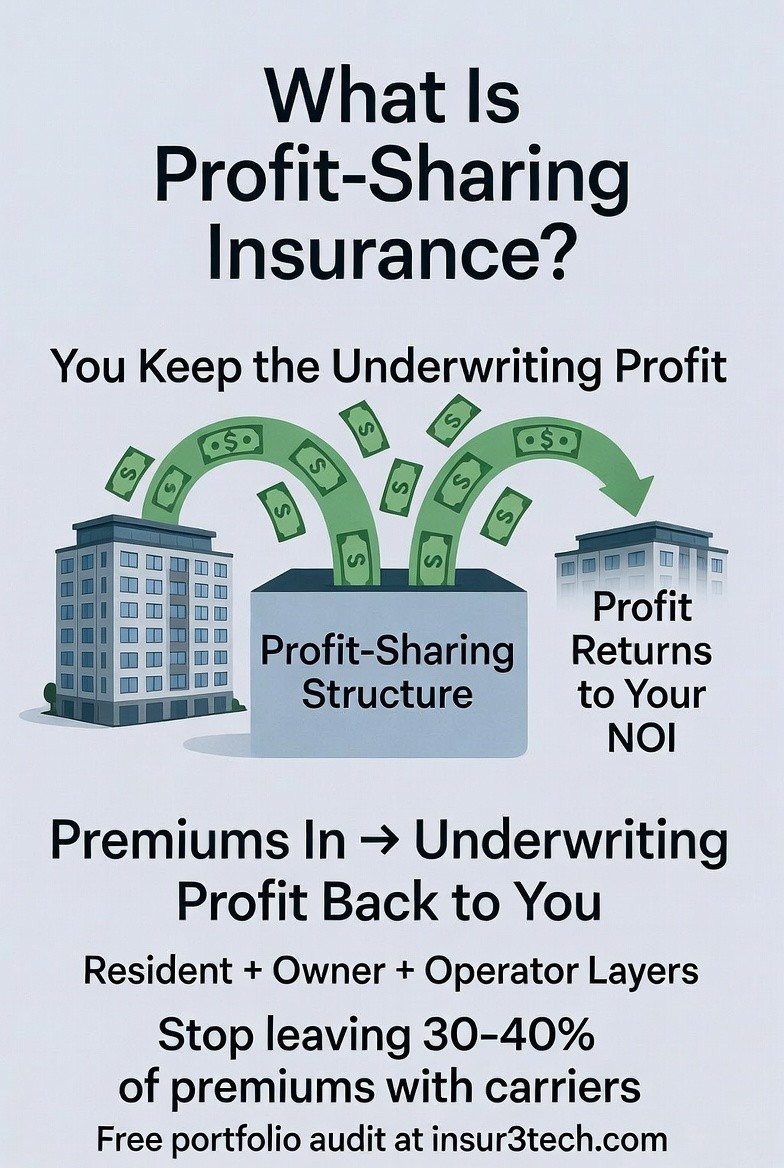
Profit-sharing insurance is not a product, it is a structure. A fundamentally different relationship between an owner or operator, and the insurance dollars they spend on their portfolio and the profit it generates. Understanding this distinction is worth more to your NOI than almost any other operational insight you will come across this year.
The standard model and its flaw
In the standard real estate insurance model, everyone involved pays premiums to third-party carriers across multiple lines: property insurance, general liability, workers' compensation, resident liability programs, and others. Those carriers collect the premiums, pay whatever claims arise, recover their operating expenses, and keep the remainder as underwriting profit.
That remainder (what is left after claims and expenses) is the profit margin of the insurance business. On a well-underwritten portfolio, it can represent 30–40% of total premium collected. It flows out of the real estate ecosystem entirely, to carrier shareholders who have nothing to do with operating the properties that generated the premium.
The flaw in this model is not that carriers make a profit. The flaw is that the operators whose risk behavior (careful tenant screening, strong maintenance programs, professional management) actually drives low loss ratios receive none of the economic benefit they created.
A multifamily operator with a loss ratio of 15% is essentially subsidizing carrier profits. In a profit-sharing structure, that same operator would keep the 85 cents on every premium dollar that did not go to claims.
What profit-sharing insurance actually means
Profit-sharing insurance replaces the one-directional premium flow with a circular one. Premiums go into a structure where the operator co-owns the profits. Claims are paid from that structure. At the end of each calendar year whatever remains after claims and operating costs is distributed back to the participating owners or operators based on their proportional contribution.
The formal mechanism varies by structure (individual captive cells, Risk Retention Groups, group captive cells, etc.) but the economic outcome is consistent: operators move from being pure premium payers to being partial owners of the profit generated by their own risks.
The three layers where profit-sharing applies in real estate
Layer 1: Resident insurance programs
This is typically the entry point and the fastest to generate returns. Residents enrolled in liability programs at lease signing generate premiums monthly. Those premiums flow into the operator-owned structure. On a well-managed portfolio with professional screening and maintained common areas, expense ratios on resident liability are frequently in the 30–40% range — meaning 60–70 cents of every premium dollar is available as profit to an insurance company.
At $15–25 per month per resident in tenant liability premiums, a 300-unit property at 85% occupancy generates $45,900–$76,500 in annual resident insurance premium. If the expense ratio holds at 30%, the underwriting profit available to ownership is approximately $31,000–$54,000 annually. That's from one property, from one insurance line. Most residents pay for 3-4 different types of insurance policies if available at their property, multiplying those profit returns accordingly.
Layer 2: Owner insurance programs
Property insurance, general liability, landlord protection, and rent guarantee programs operate at the ownership entity level. These are larger premium volumes with somewhat higher loss ratios, but the math still favors the owner or operator significantly in a profit-sharing structure. Average annual returns on property insurance premiums in well-structured programs have been approximately 20% of total premium, meaning customers can recover one dollar for every five they pay in.
Layer 3: Operator insurance programs
Workers' compensation, group health, D&O, E&O, and EPLI for the property management company and its employees. Workers' compensation has been one of the most consistently profitable lines in the U.S. insurance market for a decade. The industry loss ratio has averaged below 50%, making it a particularly attractive layer for profit-sharing structures. Average returns on workers' comp premiums in captive programs have been approximately 30% of total premium paid.
How the profit gets distributed
Distribution mechanics vary by structure, but the most common model works as follows: at the end of each policy year, the administrator calculates total premiums collected, total claims paid, and total operating expenses. The remaining amount (underwriting profit) is then distributed to participating operators on a pro-rata basis, weighted by their premium contribution.
Operators with better loss performance than the group average still benefit from their discipline. Operators with worse performance are not penalized beyond their claims. This creates a natural incentive alignment toward risk management practices that reduce claims: better screening, more responsive maintenance, stronger common area management, and less fraudulent activity.
What the numbers look like at scale
Across two documented real estate portfolios enrolled in Insur3Tech's profit-sharing structure, the combined underwriting profit returned to operators over approximately 30 months was $2.17 million. This is money that, under a traditional insurance model, would have gone entirely to carrier shareholders.
The first portfolio has 10,141 units with no prior resident insurance program. They reached a 93% resident enrollment by month 30, and are currently generating $105,000 per month in net profit back to their ownership groups. The second has 3,364 units migrating off a RealPage's eRenterPlan program. They reached 75% resident enrollment rate in 30 months and are currently generating $27,665 per month. Their loss ratio over 30 months? Less than 1% — 0.9% to be exact. One claim. Four thousand dollars. Everything else stayed with the operator as pure NOI.
Why this model has not been the default
The honest answer is information asymmetry. Insurance carriers have no incentive to tell their customers that a better structure exists. Brokers are compensated on premium volume, not on operators' profitability. And the captive and RRG structures that enable profit-sharing have traditionally required legal expertise and capital that put them out of reach for your average real estate owners or operators.
What has changed is infrastructure. The same captive economics that Fortune 500 companies and hospital systems have accessed for decades are now available to real estate operators through purpose-built platforms that handle the enrollment, compliance, syndication, and distribution mechanics — removing every barrier that previously made the model inaccessible.