2026
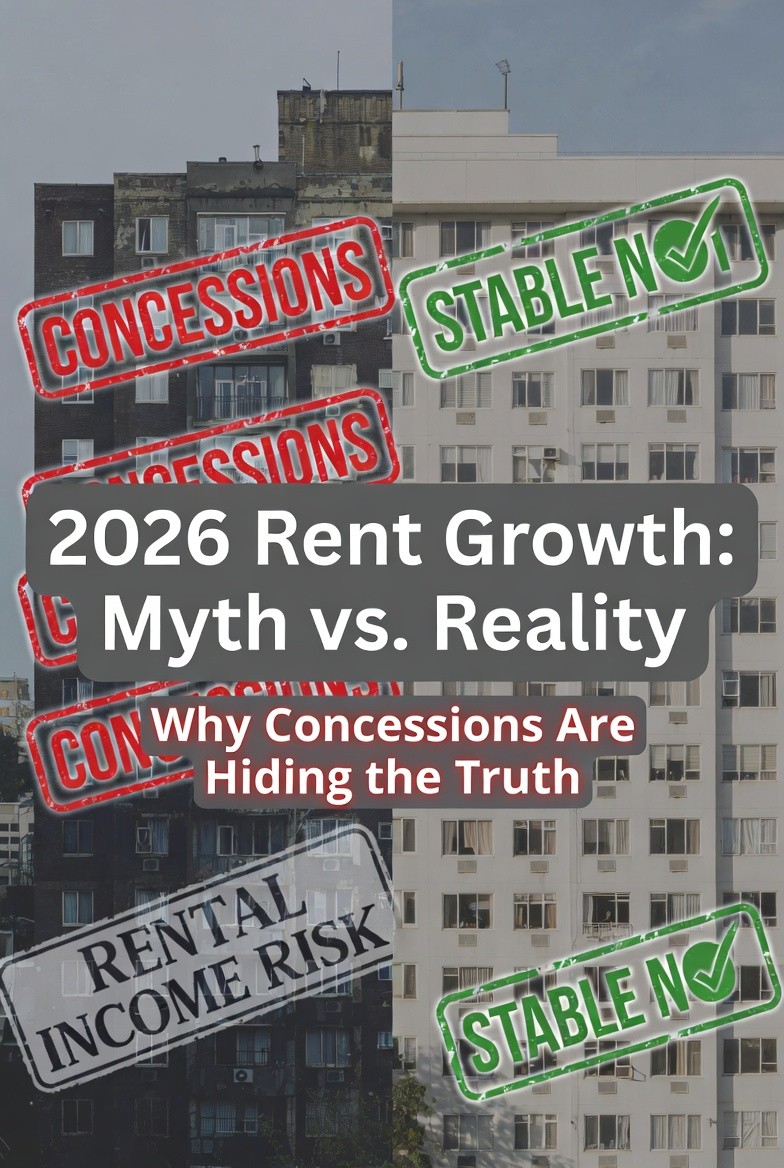
Multifamily Rent Growth in 2026: The Concession Mirage Everyone Is Celebrating
Every few days I see another headline or conference slide claiming: “Multifamily rent growth is recovering in 2026.”
And every time, I have the same reaction: Sure… if you completely ignore that 30%+ of units across major markets are still offering 2 months free rent - sometimes even 2.5 or 3 months.
Let’s do the math the way residents and lenders actually experience it.Advertised rent: $2,000/month
Concession: 2 months free on a 12-month lease
Effective monthly rent collected: $1,667
Effective annual rent per unit: $20,000 instead of $24,000
That’s not rent growth.
That’s revenue compression dressed up as stability.
The Dangerous Disconnect: Advertised Rent vs. Collected Rent
The multifamily industry has quietly trained itself to report and celebrate asking rent numbers while downplaying the massive concessions required to move velocity and hold occupancy.
But residents don’t pay asking rent. They pay effective rent.
And when 25–35% of the lease-up pipeline in many submarkets is running 8–12 weeks of free rent (sometimes more), the true NOI story looks very different from the glossy market reports.
Worse: most operators are still underwriting 2026–2027 renewals based on those inflated asking rents, not the actual cash that came in during 2025.
The 2026 Renewal Wall: What Happens When Concessions Expire
Here’s the moment of truth coming in 2026:
Hundreds of thousands of leases signed in 2024–2025 with heavy concessions roll over.
Residents have been conditioned to expect 6–12 weeks free rent (or equivalent) every time they renew.
Operators try to push back to full asking rent (or even modest 3–4% bumps).
Residents see the math, do a quick Zillow/ Apartments.com check, and realize they can get similar concessions down the street.
Result?
Renewal notices skyrocket
Retention drops
Occupancy craters
Revenue forecasts collapse
The “rent growth recovery” narrative only survives as long as operators keep giving away 10–20% of potential revenue in concessions. The moment they try to collect the full advertised rate without matching concessions, the house of cards becomes visible.
This Isn’t Just a Pricing Problem, It’s an NOI and Business-Model Problem
When your primary lever (rent) is artificially inflated by giveaways, and your secondary levers (ancillary income, operational efficiency) haven’t kept pace, you’re left with one outcome:
NOI compression disguised as flat-to-modest growth.
The scariest part? Many owners and operators are still telling themselves (and their investors) that “rent is recovering” while quietly relying on:
Ever-larger concessions
Deferred maintenance
Hope that expense growth magically slows
That math stops working when renewals turn into re-leases and concessions become table stakes again.
What Forward-Thinking Operators Are Doing Right Now
The most realistic and proactive multifamily operators in 2026 are shifting focus from “how much can we advertise?” to “how much can we actually keep?”
They’re building (or accelerating):
Real ancillary revenue streams that aren’t tied to rent (utilities, parking, storage, premium amenities, deposit alternatives, resident services)
Ownership-based insurance & risk programs that turn a traditional expense into a profit center
Resident retention engines that reduce renewal friction and concession dependency
Transparent effective-rent underwriting, modeling concessions as a permanent structural reality instead of a temporary tactic
Because the emperor has no clothes and the market is about to notice.
Bottom Line for 2026
Advertised rent growth means very little if it only exists on flyers and websites.
Collected rent and retained NOI are what pay debt service, return capital, and determine whether you survive the next cycle.
If your 2026 business plan still assumes you can remove most concessions without massive occupancy bleed, it’s time to rewrite it.
The real recovery won’t come from higher asking rents. It will come from operators who finally build a model that can generate strong NOI even when concessions are structural.